Monday, February 03, 2014

After Consultation, It Is Time To Move To APC. Let The Bridge-Building Continue - Atiku Abubakar

In 2006, as a result of my firm stand in defence of our constitution and our democracy, my supporters and I were pushed out of our party, the Peoples Democratic Party, a party that we worked tirelessly with other compatriots to build as a vehicle to restore democracy to our country.
We later returned to that party in 2009 when a new leadership of the party and the country promised a new direction, a direction of inclusiveness, of internal democracy, of an end to impunity, adherence to the rule of law and respect for the dignity of members and Nigerians.
Sadly, however, those promises have not been kept. In addition, the PDP continues to be beset with many crises, mostly leadership-induced crises. It has since lost touch with Nigerians and efforts made by many well-meaning members and stakeholders to bring it back to the vision of the founders have been rebuffed. To demonstrate the seriousness of the challenges and bring public attention to it I and some other leaders and stakeholders staged a walkout during the party’s last convention in Abuja.
As I speak, most of the issues that led to that walk-out are yet to be addressed. Many founding members of the PDP, I included, continue to be marginalized and excluded from the affairs of the party. For instance as a former Vice President, I am by virtue of the PDP constitution, a member of the party’s Board of Trustees and its National Executive Committee. However, I am not invited to the meetings of those organs nor consulted on their decisions, apparently because I dared to exercise my right to contest in the party’s primary election for a chance to be its flag-bearer in the 2011 elections. We have, therefore, concluded that that party cannot be redeemed. In short the PDP has abandoned Nigerians, the very people who gave it life and many electoral victories.
More worrisome though is the danger posed to the continued existence of this country by this culture of impunity and arbitrariness. We continue to have threats from officially protected political extremists. Increasingly our people are recklessly being divided along the lines of religion, ethnicity and region for political gains. Our history and that of many other countries in Africa and Eastern Europe ought to teach us that this is very dangerous and must stop.
We can and we must do better. Our people deserve better.

WAEC Introduces 39 New Subjects Into Examination's Curriculum

 
The West African Examinations Council has announced the introduction of 39 new subjects in its examinations.
 The Council’s Acting Head, Test Development Division, Mrs. Olayinka Ajibade, who announced this, said the new subjects would commence in this year’s May/June West African Senior School Certificate Examination.
Ajibade said this while delivering a paper titled “The New Senior Secondary Education Curriculum in Nigeria: Implications for Assessment” at the council’s monthly seminar in Lagos on Friday.
The fresh initiative, she said, was in accordance with the Nigerian Education Research and Development Council’s new secondary school curriculum.
The NERDC is the body responsible for reviewing primary and secondary schools’ curricula in the country.
She said, “The implementation of the new SSCE curricula began in September 2011, meaning that the maiden public examinations based on the new/ revised curricula are expected to be held in May/ June 2014.
“Each WASSCE syllabus is derived from the senior secondary education curriculum. In addition to the 39 new subjects for which NERDC engaged in curriculum development, curriculum review was also carried out for 35 existing subjects.”
In the new curriculum, four new subjects- Computer Studies, Insurance, Store Management and Office Practice- are in the electives category, while the remaining 35 subjects are in the Trades category.
Among subjects in the trade category are Painting and Decorating, Photography, Salesmanship, Plumbing and Pipe Fitting, and Upholstery.
Ajibade added that under the fresh directive, students would be required to take four core subjects, comprising English Language, General Mathematics, Civic Education and Trade/ Entrepreneurial Studies.
The candidates, she added, would be required to choose three or four subjects from Humanities, Science, Technology and Business Studies depending on their potential and interest.
 Ajibade, while unveiling this, noted however that the new directive would face some challenges.
She identified inadequate teachers, appalling state of facilities in schools and large class size as some of the challenges that would likely beset the initiative.
READ MORE:  http://news.naij.com/58293.html

Friday, January 31, 2014

Comedienne Princess And Wizkid Get Cozy

Popular musician Wizkid and comedian Princess were spotted on set of the video shoot for Sound Sultan and Wizkid's Kokose video.
'Kokose' is a track from Sound Sultan’s new album 'Me, My Mouth and Eye' featuring star boy, Wizkid and produced by Legendary beats.
Sound Sultan is a Nigerian rapper, singer-songwriter, actor, comedian and recording artist. He is regarded as one of the pacesetters of modern hip hop music in Nigeria.
Check out the photos below:

READ MORE:  http://news.naij.com/58096.html

Beyonce Shares More Adorable Family Pics

Mega-star artist and actress, Beyoncé Giselle Knowles-Carter, simply known as Beyoncé, has shared some beautiful photos of herself, Jay Z and their daughter Blue Ivy on her personal blog.
Beyonce, who bared it all and got sexual with Jay-Z during Grammy performance is now presented in an absolutely different environment.
See the beautiful snaps below: 
Beyonce Shares More Adorable Family Pics

Shakira - Can't Remember to Forget You ft. Rihanna

Shakira and Rihanna have unveiled
the video for their single 'Can’t Remember to Forget You,' and when two
of the world's sexiest women collaborate, what do you expect? Skimpy
outfits, naked embrace, dramatic hair flips and a near-kiss.
The songbirds really showed themselves in the saucy video and tried to
outdo each other. Watch it after the cut and tell us who you think
really rocked the video. I choose Shakira, nobody does the hip movement
like her. Enjoy...


Mercy Johnson and Rukky Sanda visit iROKOtv HQ

Mercy Johnson and Rukky Sanda paid a surprise visit to the iROKOtv team at their Lagos offices in Anthony Village on Wednesday January 29th. Everyone was overjoyed to meet and spend time with the actresses, as well as show them around the beautiful new office space, recently acquired by the company. More photos after the cut...

Meet actress Shan George's grown up sons

Nollywood actress Shan George has two sons but who knew they were this grown up? The twice married 45 year old actress pictured above with her sons, 27 year old Delnoi (pictured left) and 25 year old Jaga pictured right. The young men are both graduates of University of East London. Jaga is a Hip Hop musician. See more after the cut...

Wednesday, January 22, 2014

Aliko Dangote to invest $300 million in rice production in Nigeria

Nigerian Minister of Agriculture Akin Adesina, who is in Davos with Dangote and others revealed this info on his Twitter page...

Peter Okoye shares photos of his cute daughter as she turns 1 today

 
she's so beautiful! The proud papa shared the photos above of Aliona Okoye as she celebrates her 1 year birthday.

New trial sought for SC boy, 14, executed in 1944


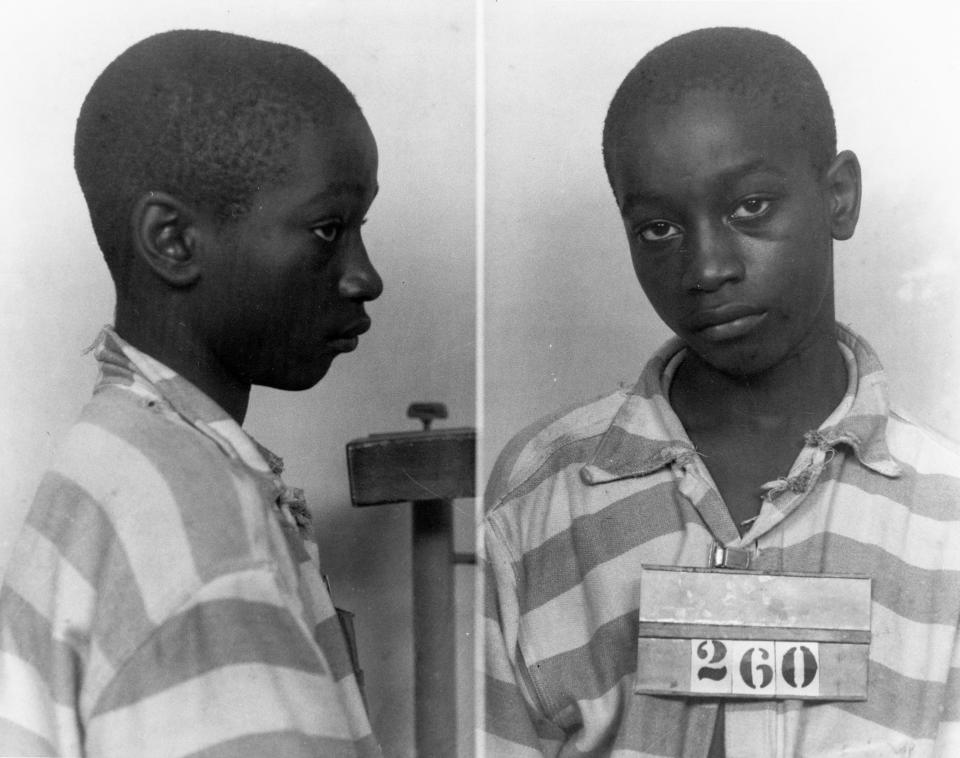
FILE - This undated file photo provided by the South Carolina Department of Archives and History shows George Stinney Jr., the youngest person ever executed in South Carolina, in 1944. Supporters of Stinney plan to argue Tuesday, Jan. 21, 2014, that there wasn't enough evidence to find him guilty in 1944 of killing a 7-year-old and an 11-year-old girl. The black teen was found guilty of killing the white girls in a trial that lasted less than a day in the tiny Southern mill town of Alcolu, separated, as most were in those days, by race. (AP Photo/South Carolina Department of Archives and History, File)A 14-year-old black boy executed nearly 70 years ago is finally getting another day in court, and his lawyers plan to argue Tuesday for a new trial, saying his conviction was tainted by the segregationist-era justice system and scant evidence.
George Stinney was found guilty in 1944 of killing two white girls, ages 7 and 11. The trial lasted less than a day in the tiny Southern mill town of Alcolu, separated, as most were in those days, by race.
Nearly all the evidence, including a confession that was central to the case against Stinney, has disappeared, along with the transcript of the trial. Lawyers working on behalf of Stinney's family have gathered new evidence, including sworn statements from his relatives accounting for his whereabouts the day the girls were killed and from a pathologist disputing the autopsy findings.
The novel decision of whether to give someone executed a new trial will be in the hands of Circuit Judge Carmen Mullen. Experts say it is a longshot. South Carolina law has a high bar to grant new trials. Also, the legal system in the state before segregation often found defendants guilty with evidence that would be considered scant today. If Mullen finds in favor of Stinney, it could open the door for hundreds of other appeals.
But the Stinney case is unique. At 14, he's the youngest person executed in the United States in the past 100 years. Even in 1944, there was an outcry over putting someone so young in the electric chair. Newspaper accounts said the straps in the chair didn't fit around his 95-pound body and an electrode was too big for his leg.
Stinney's supporters said racism, common in the Jim Crow era South, meant deputies in Clarendon County did little investigation after they decided Stinney was the prime suspect. They said he was pulled from his parents and interrogated without a lawyer.
School board member George Frierson heard stories about Stinney growing up in the same mill town he did, and he has spent a decade fighting to get him exonerated. He swallowed hard as he said he hardly slept Monday night.
"Somebody that didn't kill someone is finally getting his day in court," Frierson said.
In 1944, Stinney was likely the only black in the courtroom. On Tuesday, the prosecutor arguing against him will be Ernest "Chip" Finney III, the son of South Carolina's first black chief justice. Finney argued Tuesday there shouldn't be a new trial because the evidence was lost with the passage of time, not destroyed.
"Back in 1944, we should have known better, but we didn't," Finney said.
Finney has said he will conduct an investigation if a new trial is granted, but what that might find is not known. South Carolina did not have a statewide law enforcement unit to help smaller jurisdictions until 1947. Newspaper stories about Stinney's trial offer little clue whether any evidence was introduced beyond the teen's confession and an autopsy report. Some people around Alcolu said bloody clothes were taken from Stinney's home, but never introduced at trial because of his confession. No record of those clothes exists.
Relatives of one of the girls killed, 11-year-old Betty Binnicker, have recently spoke out as well, saying Stinney was known around town as a bully who threatened to fight or kill people who came too close to the grass where he grazed the family cow.
It isn't known if the judge will rule Tuesday, or take time to come to her decision. Stinney's supporters said if the motion for a new trial fails, they will ask the state to pardon him.

Contributors